5 April 2013
Rainforest Spiritual Enslavement - Black Magic Cannot Cross Running Water
God damn. Can Blackest Ever Black do any wrong? Complementing their existing roster of dark ambient, minimal and industrial artists, their latest release comes from Rainforest Spiritual Enslavement, who's black magic rituals for Hospital Productions so far have been utterly superlative. Stretching synth tones and industrial malfunctions out until they attain monolithic proportions, Rainforest Spiritual Enslavement craft a form of ambience that drowns modern electronics in a brutalist swamp of afro-dread. Whilst previous releases have drawn comparisons to Raime, with their skeletal beats and noticeable dub-influence, Black Magic Cannot Cross Running Water is a mostly beatless affair more indebted to Carpenter, Lustmord and Frank Bretschneider - the second track Refugees From Black Magic opens with a strangely ominous patter of rainfall that develops a loping half-rhythm before being subsumed under a wash of crepuscular synth noise. Top quality music.
13 July 2012
Scuba - The Hope (Recondite mix)
Hot Flush's latest release is another pretty solid Scuba remix outing, with Recondite offering up two interpretations of The Hope, the deliriously ravey cut from February this year. Rather than upping the ante, Recondite strips away the majority of Scuba's original track, retaining only the distorted voice, and filtering down the bass to a warm, resonant low end. Whilst the two reworkings are intended to conjure different time periods, named Nocturnal Car Ride and Morning Promise respectively, they're fairly similar aesthetically and channel a smoked out, deep-house vibe. Admittedly, the former focusses slightly more on the bass and the lower end, whilst the latter stretches the hi-end synths into ambient/ Kraut waves, whilst winding the percussion down to a more minimal groove.
I'm definitely more enamoured with the Nocturnal cut, but both tracks are solid DJ tools with great potential and rich sounds that will get a few good outings.
28 June 2012
Perc - A New Brutality
Perc Trax latest EP is more of what you'd expect from the label that's established itself as the port of call for brutalist techno - unrefined, uninhibited, noisy and drug-fuelled sonic battery. From the no-signal tone that opens the record, and the sweeps of white nosie, to the double-kicks and murderous bassline, the title track is the kind of brilliantly devastating industrial techno that is to speed what The Melvins are to Afghan black. With a sense of mechanistic decay and corrosion seeping through, Perc pushes his meltdown to a place somewhere beyond the dancefloor, but with just enough to rythym and drive to keep it techno. Whilst Boy is similarly devolved techno, there's far more melody and warmth involved, and it with it's half-step and breakbeat influences, seems to be aiming for the kind of ground Surgeon occupied on last year's Breaking the Frame. It's on Cash for Gold and Before I go that Perc really comes into his own, displaying strong Cabaret Voltaire / post-punk influences and moving into the realms of experimental electronica without losing his techno grounding - the former sees Perc working his favoured brokenbeat style, with analogue bleeps and groans crafting a mournful landscape. The latter serves as a dark coda to the record, combining piano and organ chords with malfunctioning machinery and scratchy tape delay reminiscent of Max Richter. Both tracks apply a similar aesthetic of decay and antiquity via brooding melodies and lo-fi recording quality, and the end result feels like a silent film soundtrack, tying in with the starkess of the cover.
The title track may be AFX level of Rargh-techno masochism, but the 'new brutality' Perc unveils is more of the slow-burning, brooding emptiness than predictably unrelenting noise, and there's moments of beauty to be found in the darkness. One of their better releases.
8 May 2012
Guy Andrews - The Wait (Hotflush Records, 28 May)
Perrenial Shallowrave favourite Guy Andrews follows up his acclaimed 12" for Hemlock with a dark dancefloor killer for Hot Flush, undoubtedly one of our favourite labels. Whilst we've had nothing but good things to say about Andrews' post-rock/ambient output, it definitely feels that he's hitting his stride as a producer with his recent dancefloor 12"s - Iambic's focus on soundscapes, texture and the wall of noise limited the potential for narrative and drive. The transition to more focussed and beat-driven productions sees Andrews using his readily-established talent for composition and rhythm to create powerful bass music hybrids. Mixing snippets of acid basslines, complex percussion and warm, reverb-heavy synth lines, The Wait is one of those brilliantly wtf?-inducing tracks that deserves to be absolutely massive, whilst Hands in Mine continually fakes out the listener, mixing Mount Kimbie-esque walls of noise and Baile funk percussion before dropping into something that sounds a bit Kode9's Too Far Gone, a bit like Music era Talking Heads and a lot like what James Blake wishes he was making.
Andrews work sits nicely alongside other releases from Hot Flush and Hemlock, mixing many of the elements that both labels helped to build. However, unlike some of his labelmates, Andrews never sounds like a techno producer incorporating R'n'B elements, or a dubstep producer who's listened to too many Ostgut records; like Shades/Textures before it, The Wait feels like someone approaching dance music with a completely blank slate, incorporating whatever elements appeal to them, rather than attempting to emulate existing artists. His mixes (see below) clearly demonstrate a pretty solid knowledge of current dance music, yet The Wait feels brilliantly naive and unencumbered in both production and composition. Awesome work.
http://soundcloud.com/guyandrews
4 April 2012
Bass Clef - Reeling Skullways (Punch Drunk, 30 April)
Shallowrave likes Bass Clef - watching him rise over the past few years, we've been in attendance at some wickedly screwy live sets in the Subby and in Stereo and repped his EP's as best we can. So a new full length on the excellent Punch Drunk is very welcome, and sees 'Clef unveiling a totally different style to his traditionally freeform dub/noise/IDM blend. Taking his cues from the wonkier moments of Chi-town and Detroit, Reeling Skullways is nine tracks of house twice-removed; a roiling mix of analogue modulation, swung four-to-the-floor rhythms and epic cosmic riffs. Whilst A Smile Is A Curve That Straightens Most Things, Hackney Centralist and Cumbers' early works are strongly carnivalesque, with trombone riffs and sampled MC lines, Reeling Skullways focusses more on the delicious quirks of analogue kit, and draws heavily from Model 500's space-age feel. Equally, the likes of Hackney-Chicago-Jupiter and Suddenly Alone Together show a far more focussed side to Cumbers, being edited and arranged into more coherent dancefloor numbers than the deliciously erratic Clapton Deep or Promises. Most striking is Embrace Disaster, where the warm analogue heart, delicate synth strings and conga percussion come together to create something that sounds like a beefed up Moroder classic.
Whilst Reeling Skullways first gives the impression of being some strange new beast, it's possible to hear elements of Cumbers' past experiments across the album, from the echochamber and delay work on Stenaline Metranil Solar Flare, to the EkoClef-esque industrial grind on the opening and closing beatless segments. It's a singularly bold step forward however, and opens up many new possibilities for Bass Clef.
15 February 2012
Model 500 - Control / The Messenger
Model 500's triumphant return with OFI led to much rejoicing, and it understandably made many people's record of the year last year. The pounding techno undercarriage, coupled with maniacal electro riffs and magic Juan back in full force with epic rants about the mothership, time travel and dimensional shift, made for a genre-crossing dancefloor destroyer. Model 500's latest 12" however sees Juan setting control for the heart of the sun and heading into far more cosmic territory, layering up floaty synths and woogy-woogy theramin melodies that are all kinds of awesome. Despite Model 500's reputation for hell-for-leather electronic madness, both sides of the 12" are heavily influenced by the kind of machine-driven bleep-techno that Sleeparchive and Mika Vainio have made their mainstay, with Control translating analogue fetishism into a rolling italo number, replete with vocodered vox and flailing synth lines. It ought to be a jarring clash of styles, but Atkins weaves together the underlying fascinations with analogue equipment to create a brilliantly uncomfortable piece of machine funk. I can't say the vocoder impresses me, but it does add to the whole "this is detroit electro... in space!" vibe. The Messenger is less scattershot, boosting the theremin to the forefront of the mix and thankfully cutting out the vocals, it makes for a suitably epic B-side, that frankly outshines the A.
My only criticism of this record is that Model 500 seem straightjacketed by the electro template, unable to move beyond high-speed synth riffs and hip-hop beats, and admittedly neither track does much to change this. However, between Control's anashamedly retro sound and The Messenger's epic cosmic feel, there's plenty to like about it.
26 December 2011
Coki - Don't Get it Twisted
DMZ have done a great deal of good as part of London's bass music scene, and I was particularaly vocal about Mala's epic remix of the Moritz Von Oswald Quartet; their cross-over into more techno-influenced territory and gigs in Berghain have only served to cement my respect for the work they do. However this record from Coki feels like a step backwards, a regression to dubstep's ket-friendly, strictly-formula blend of massive basslines and loping percussion that feels tired and done to death. Tree Trunk opens the record promisingly with Carpenter-esque horror-synths and breathy atmospherics, building the kind of hypnotic dub Pinch or Martyn do on their best days. And then the bassline comes in. All nippy high-end and wrenching pitch shift, it murders the majority of the mix and is an unpleasantly abrasive addition to what was shaping up quite nicely - when the drop hits, it reverts back to being a well-engineered, intriguing track. Following it up with Lower Octave, Coki fires back in with exactly the same kind of nagging look-at-me sawtooth synthline that dominates everything in sight, and the predictable one-and-threes kick & snare pattern. Obviously it's a question of taste, but in comparison to the substantial body of work Coki had amassed, and the reputation of DMZ, this feels immature and badly-worked.
The biggest shame about this record is that the second plate is a pretty solid piece of work - Celestial Dub's hydro-inflected organ is a thing of beauty and adds a much needed dubby element to the record, offsetting it with mental levels of delay on everything. Everything. Leaving aside the brain-melting basslines, Coki builds up a very competent and blissfully stoned steppa's riddim that deserves a good run out. The fourth side of this EP again throws a total curveball, and garners that same "what the hell has he been smoking?" reaction that Boomba brought out - the bassline flip-flops around, contorting and meandering, whilst a plethora of Bomberman melodies skew across the top. It's as abrasive as anything off the first disk, but the level of surrealism and completely over-the-top nature make it a genuinely interesting piece of work. Buy the tracks digitally.
29 November 2011
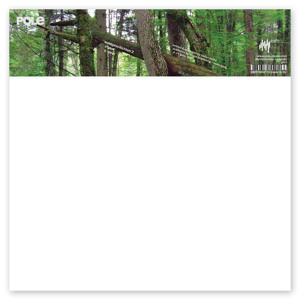
Pole - Waldesgeschichten 2, Dec 5th
I was pretty excited by Pole's first release on his new label, and enthused about the new ideas he's been working with, so it's pleasing to see him gather momentum with the follow up 12". Warm and resonant subs underpin Pole's trademark glitchy sound and shuffling, rootsy structures, fusing the best of techno and dub with the kind of syncopations more often seen in the work of Headhunter, 2562 and Martyn. There's a far more distinct sense of narrative to Aue and Pirol than exhibited on the first Waldesgeschichten, with more evident build ups and breakdowns, despite being built around long, evolving loops. Equally, the tension between Aue's solid, bass-driven repetitiveness, and off-kilter two-step bounce of Pirol gives the EP a sense of structure with it's contrasting styles.
Continuing in the same Romantic vein as the first EP, the track titles are drawn from natural imagery - Pirol is a vibrant yellow songbird, whilst Aue roughly translates as grassland - and channel the same sense of vitality and organic growth. Betke's work has often focused on the mechanistic, fetishising technology and searching for the ghosts in the machine, but this change in direction is a welcome refresher, without losing sight of what make his work so special. A-Aue-Excerpt by pole original
B Pirol-Excerpt by pole original
Pole plays the following dates in December, if anyone wants to buy me a ticket to Berlin...
2 September 2011
Lukid - Spitting Bile
It's a rare joy, when writing about and analysing music on a near-constant basis, to come across something that causes you stop dead and say "I have no idea what the hell this thing is". Lukid's popped out a couple of these in his so-far-short career - his first 12" on Glum might, if you squinted and gave it the benefit of the doubt, look a bit like house, and his previous majestic efforts for Werk are best filed under "sort of instrumental hip-hop, with more bleep but also some Theo Parrish". So how then to discuss his second 12" for Glum, a four-tracker brimming with ideas and new styles?
Opening with My Teeth in Your Neck, there's shades of Madlib and Dr Octagon, but also a fair heft of wonky house that nods to Moodymann or Shake Shakir; a kick drum beats out a solid 4/4 at 120ish, whilst the hi-hats and claps shuffle about in the mix like a nervous tic. Pitched in some ungodly register, the lo-fi synth channels a bit of Manitoba/ Four Tet wonk, to further confuse the matter. It gets no easier to pigeonhole for the remainder, with Park it Low retreating into more recognisably broken structures a la Onandon, and Dragon Stout heading for 8-bit gameboy territory. Title track Spitting Bile is yet even more WTF?-inducing, building a shuffling breakbeat, throwing in a 4/4, then obliterating it all with a saw-edged synth just as it's starting to build to something, then working its way back down again.
More than just being 'wonky' or experimental, Luke Blair has managed to make something that just feels, well, wrong - the rhythms, key signatures, dynamics and arrangements all push the limits of accepted convention to make a weird geek of a record. And yet, it's somehow very right and very cool.
17 August 2011
Scuba - Adrenalin
It's no secret that Shallowrave has a bit of a thing for Scuba - as well as keeping the truly epic Hotflush record label turning out next-big-thing after next-big-thing, Paul Rose's role in bringing together the globe's different strands of bass music is second only to that of Kode9, and frankly, Aesaunic is a better single work than anything Goodman's managed. Seriously.
His latest offering, a 3-track EP on Hot Flush, once again utterly nails it; welding the broken glamour of UK garage onto a framework of purist Detroit beats and widescreen synths, it's a rich, euphoric piece of work that channels all the best bits of dub , R'n'b, techno and hip-hop into a seething dancefloor mess. Casting aside Scuba's previous propensity for cloying bass and Berghain-inflected doominess, Adrenalin occupies a weird mid-ground between Joy O and Carl Craig, with it's crisp, floaty synths, vocal samples and garagey bassline sneaking along in the background. It's dead on the money and sets the tone for two more monsters. In contrast, Never rips wholesale from the best of Afrika Bambaata, layering up that boom-bap with some gloriously rich synth lines and building a brilliantly twisted take on London garage. Closing the record, Everywhere sets up a beautiful piano riff that ultimately ends up a bit of a let down when the drums and vocal sample comes in and it gets all Prince. It's by no means a bad track, but the B-side just cries out for a dark and mangled dub, rather than a third dose of 808-driven uber-house. Good work from Scuba, and definitely his most dancefloor-centred to date.
3 August 2011
Four Tet - Fabric Live 59
I've never been the biggest fan of Fabric's output as a whole; amongst the undoubted greats (Shackleton, John Peel, Jackmaster), there's a few that date badly (Nitin Sawhney), or really just don't do it for me (John Digweed, LTJ Bukem). Occasionally, they pop out the kind of mix that keeps you fascinated for weeks and totally redefines the idea of a 'mix'. Four Tet's approach to his Fabric mix isn't quite the magnificent slice of awesomeness that Shackleton's was, but it does manage to do away with certain conventions, and surprisingly accurately convey his uniquely weird approach to production and performance. Based around a framework of 90s 2-Step and Grime, Hebden has tracked down vinyl rarities, ripped digital versions from records and recorded found sounds from Fabric itself in an attempt to convey his sense of what a night out feels like, rather than merely blending tracks as anyone else would have been happy to do. It's a headfuck, and stands up as one of Fabric's more unique releases, taking in Burial's mournful Street Halo, C++'s hyperactive Angie's Fucked, compositions Four Tet created especially for the compilation, and crafting them into a surreal musical masterpeice. Definitely one of Fabric's more interesting releases.
29 July 2011
The Black Dog - Liber Temple
The link between Sheffield's heavy industry and its avant-garde electronic ouptut has long been acknowledged by the likes of Cabaret Voltaire, Warp and The Black Dog. The latter's second 'book' in the Liber series (leading into the album Liber Dogma to be released on Soma) sees them laying down some crunching industrial, channeling Sheffield's technological heritage into powerful dancefloor material reminiscent of Dettman or Ancient Methods. Heavy Industry draws it's kickdrums from drop forges and it's hi-hats from steel cutlery production, which in other hands could easily become worthy explorations of samples and little else, but in the right hands becomes utterly devastating. Opening with a deceptively mellow analogue bleep, The Black Dog then proceed to bludgeon the listener with a rapid-fire distorted bassline that shakes cones and devastates speakers, and then that kick drum comes in.
Holy shit.
Mechanistic and brutal, without ever losing any of it's dancefloor credibility or subtle melodies, Heavy Industry manages to at once convey images of industrial Britain and all its character and power, whilst still giving us the kind of late night floor filler that Surgeon or Monolake would consider devastating.
It's a shame then that Greedy Gutter Guru fails to provide the same kind of powerful fix, contentedly chugging along where Heavy Industry hit a hard gallop. There's the same power to the samples - the hi-hats allowing even more of the original clatter to permeate through - but the Detroit-inflected synths detract slightly from the percussive fist-fuckery, and there's less of the emotive dynamics that make the A-side such a beast. Still, there's fun to be had with it, and if this is the mid-trilogy placeholder that paves the way for a devastating finale, the third one ought to be an absolute monster.
21 July 2011
The Black Dog - Liber Kilt
The Black Dog return with some of their most dancefloor orientated material for some time, having worked their way across the entire spectrum of electronica, techno, dub and ambient. There's still an underlying mystic theme to it all, brought out by their recent collabs with The Psychick Warriors of Gaia, but this is predominantly for DJs, not 6am stoned spiritualists. Opener Black Chamber Order is as epic as you'd expect from the title, with floating layers of synths intertwining and collapsing as the track builds up, leading into a super-heavy bassline that builds into a massive, warehouse-filling beast. Double A-side, Bass Mantra is even more ridiculously bass-driven, opening with Sahko-esque analogue tones passing through a delay cycle, before a cone-shaking bass wobble groans into life and the percussion picks up. Domintated by the groaning bass, Bass Mantra gallops along, dragging in more cold analogue tones and reverb-heavy snare smashes that come across like some of Regis' lighter works. Prestty awesome single, and the first of three!
10 July 2011
George Fitzgerald - Silhouette EP
George Fitzgerald follows up his fantastic work for Hot Flush with a 3-track EP for the equally awesome Aus Music, who've gone from being a solid house/ techno label, to putting out some of the best cross-genre records in less than two years; Carl Craig remixing Ramadanman & Appleblim, Ramadanman and Midland's collab, Joy F'n Orbison.
Fitzgerald's pushed a lot of the right people's buttons with his mix of R'n'B, house and dubstep, and I was about to criticise this one for being overly-predictable, decent enough garage. Until I released my promo copy's been mislabelled. The B-side Reset (which I had as the flagship track) is a rolling, off-time garagey/r'n'b number that takes its time working over a single vocal line and offbeat piano stabs. It's pretty decent, but doesn't even come close the crossover potential of The Let Down, and frankly, the vocal's fucking irritating. Equally, the remix of Silhouette, by John Roberts, is this loping, weirdly played purple wow/ hip-hop number that doesn't know if it's trying to be smart electronica or a quality banger and had me ready to pan the release as a missed opportunity.
Then we get to Silhouette.
Holy Shit. Big analogue synth line warping through delays, epic smashes of white noise and irresistibly funky percussive riffs; big tune. Building up over time, it eventually bursts into a lush, drawn out slice of techno, with a looped and chopped vocal acting to drag the tune to new heights. Then, with the briefest of drop-outs, a monster sub-bass line kicks in and it all gets messy, turning it into one of the best tunes I've heard for months. This one's going to be big; I did find myself wondering why such a magnificent piece of work was consigned to the B-side. Buy it.
9 July 2011
Deepchord - Hash Bar Loops
Deepchord - Hash Bar Loops (Soma)
I've always enjoyed Rod Modell's work as Deepchord - his ability to manipulate and deconstruct the basic building blocks of house, techno and dub has made him one of the most intriguing modern electronic propositions, and the depth of sound conjured is second to none. Previous album The Coldest Season, released on Modern Love, rather than his own Deepchord imprint was a perfect synthesis of his sparse dub sound and Modern Love's own experimental ethos, so bearing in mind Soma's reputation for dancefloor-orientated house and techno, one would expect this to contain more focused material than the twenty minute live performances he's taken to putting on the flip sides of vinyls as CV313. Opening with Spirits, we plough headlong into proper Deepchord territory; delicate washes of white noise, massively refined sound-desk work and groans of synthesisers slowly sweeping and decaying, before building into Vainquer-esque dub-techno on Stars and Sofitel. The majority of the album sticks with a similar sound palette of cavernous bass, far-away synths and reductionist percussive riffs, but with these simple tools Hitchell manages to build a narrative that guides us through Amsterdam (where the album was recorded), from the heady, stoned vibes of its coffee shops and bars, to the throb of the city centre and the blare of its red light districts and nightclubs. There's few obvious breakdowns, and like most of Deepchord work, it seems to be extracted from long, extended jams rather than designed for DJs. At the heart of the album is the shuffling Oude Kirk, which utilises a chattering percussive riff reflecting Amsterdam's ever-moving tramways, and smoothly seques into City Centre, the most focussed track of the album with a kickdrum high in the mix, sensory encounters fleeting, transient and washed away into nothingness.
Closing the album off are Black Cavendish and Neon and Rain, polar opposites of the bustle at the heart of the album that paint a much bleaker picture. Black Cavendish, again focusses on a kickdrum, but elevates it high into the mix, with a claustrophobic amount of sub-bass. With hisses panning around the speakers and little let up, it serves as a paranoid counterpoint to the sunny dub of Merlot or Balm and leaves the listener drained and shaken. In contrast, Neon and Rain is a beatless, doom-laden peice of ambience that draws all colour from the synth stabs and groans with far away blasts of noise. It's the perfect coda to a powerful piece of modern dub that proves Modell is a force to be reckoned with.
1 July 2011
Bass Clef - Rollercoasters of the Heart / So Cruel
The summer has landed! our very favourite trombonist / dub manipulator Bass Clef drops in with two unique dub-techno variants for Peverelist's Punch Drunk label. As his live shows will attest, Bass Clef isn't one to rely on heavy amounts of technology, prefering to spin simple drum loops and augment them with live improvisations; Rollercoasters takes on similar format, with it's basis in a simple, quaking bassline and a jump-up beat, throwing in chopped-up vocals and a euphoric piano riff. Two parts classic rave to one part Scientist-esque dub work, it's weirdly offbeat, earth-shakingly heavy and totally awesome. So Cruel sees Bass Clef reinterpreting the hard-nosed styles of UK bass bass music in his own loping fashion, throwing in not only a speaker-wobbling sub, but a melodic bassline over the top and scattering a loose percussive pattern across the mix. There's hints of UK funky in the skittery R'n'B inflected vocals, but as usual it's surreal, deep and mildly confusing. Much like Barry Lynn's Boxcutter project, Bass Clef is a truly unique proposition that proves impossible to pin down, and despite this being vaguely in line with Punch Drunks previous releases, Rollercoasters of the Heart is something totally new for Punch Drunk.
30 June 2011
9West - Velvet EP
Dessous continue to turn out more subterranean house, with a four track EP from Greek duo 9west, who's debut EP for the label dropped last year. I recently praised Steve Bug and Cle's new EP as a return to form for Poker Flat, and now Bug's pulled the same trick with Dessous; this is the kind of rich, late-night house music that the label's famous for. Good shit.
Opening with Chasing Demons, 9west summon up a lush palette of bongo-laden percussion, whispered vocals and loping synth riffs, building a long-running deep house epic from a vast array of elements; hardly devastating, but definitely one to build up with. There's much of the same on the other three tracks, with Moments leaning heavily toward Detroit, ratcheting up the tension via swelling synths and percussive drop outs, whilst the second half of the EP showcases a more dub-friendly palette of delay and comfort-reverb. It's with the latter that 9west shine; their sound's so heavily layered that the more straight-forward 4/4 material can feel a little too complex, whereas when they draw out a single idea over the course of one track, it's far more effective. Velvet's definitely the stand-out number, reminiscent of Trentemoller's Moan with it's recurrent two-note lament and ethereal vocals, whilst The Big Picture is perfect after-hours music that slowly draws the EP to a close.
16 June 2011
Steve Bug & Cle - Seven Hills
Poker Flat return to proper late-night form, with a cracking 12" from head honcho Steve Bug, accompanied by long-time collaborator Cle. Reductionist in the way that only Bug can be, the two tracks tease extended breakdowns and epic synth swathes out to create an awesome blend of techno and deep house. Opener Seven Hills teases delay-heavy analogue chord and a single kick-drum out almost to the point of frustration, before slowly raising the pace with vintage hi-hats and lone snare drum; extending the delay and accentuating the hi-hats, layers lowly filter in and it builds into a more driving dancefloor track. Becoming relentlessly more epic over the course of a two and a half minute breakdown, it all falls into place at the drop, eroding into trails of delay and echo. With a slightly more Detroit feel, Monkey Shoulder kicks in a lot swifter, with jacking metallic cymbals rattling around in the mix. Dropping elements in and out, there's far greater sense of dynamics at the work, though it's no less extensive in its scope.
Poker Flat's last couple of releases haven't really had me looking to hamburg with any eagerness, but with Bug and Cle turning out material of this caliber, there's proof that it's still got the chops. Damn fine EP.
27 May 2011
Deadboy - Here (Nmbrs)
The cover says it all really; the almost Rocky Horror-esque, oversexualised lips splintered and fragmented, rearranged as an offbeat interpretation of a classic image. Deadboy's second vinyl for Numbers, after the excellent (though frustratingly one-sided) If You Want Me is another slice of achingly cool dancefloor destroyers that take the classic house template and move everything to the wrong places in the best possible way. Opening with his trademark fuzzed-up synths and filtering vocals, Wish You Were Here has the kind of epically lush intro you're going to spot a mile off, and rinses it for all it's worth, before dropping into a bouncing, 4/4 house riff, replete with off-time woodblocks and claps. With every new synth line and vocal filter, it just gets more hands-in-the-air and is a surefire set finisher for the likes of Jackmaster, Joy O et al. Here For You and Aint Gonna Lie are no less glorious, working synth lines that recall vintage Inner City against loping funk riffs, rolling bass and big drop-ins. Hell, Here For You even manages to work in bongos and tabla without sounding cheesy.
My only sticking point with this record is that whilst Deadboy, fitting perfectly with Numbers ethos, DJs right across the board (Detroit electro, classic house, hip-hop and dubstep all get a work-out), Here ties in all of these, but is just slightly too cleanly produced; there's just not enough growl, grit, or dirt smearing the record. Maybe it's just too much of Kode9 and Burial, both of whom work with similar dubstep-garage-house variants, but Here lacks the dark side that throws the light into perspective. Final track / B-side Aint Gonna Lie comes closest, with the vocals detuned, the synths pitchbending mournfully, and a seductively deep bassline rolling along. Still, it's a cracker of a record, and after the frustratingly limited one-sided debut, it's good to hear more from Deadboy.
26 May 2011
Surgeon - Breaking the Frame
Anthony Child returns to his Surgeon moniker with his first album in just over a decade, channeling everything from the brutalist techno of British Murder Boys, to his more experimental works with Karl O'Connor and Mick Harris into a seething melting pot of electronic head-fuckery. Considering Surgeon's vast body of work, plus his status as one of techno/dubstep's most singular DJs, there's a lot piled into Breaking the Frame - the gatefold artwork alluding to this with it's chaotic mix of colour and shape.
Dark Matter opens the record, with a series of analogue tones and glitches taken straight from Mika Vainio lilting over a subtle sub-bass, before Transparent Radiation rolls in like T++ or Dettman turning it up to full volume. We get the same treatment with Radiance and Power of Doubt, both running on grinding metallic pads and barely recognisable snares and hi-hats, utterly demolishing everything in their way. This isn't just a case of 4/4 destruction throughout though; Child continually shifts the dynamic of the tracks, ending one set of beats halfway through and giving way to an epic run-out of keys on Transparent Radiation, and indulging in some more Autechre influenced down-tempo work on Remover of Darkness.
It's undeniably Surgeon, contrasting the raw, to-the-knuckle techno, with warpy, melodic and offbeat passages. At times though, it almost feels like the repetitive beats are merely there as an afterthought, and Breaking the Frame focuses more on space, depth and atmosphere, floating off towards the end in a haze of analogue blurs and washes of sound.